

Deconstructing early U.S. immigration statutes, legal language, and the historical reality behind colonial naturalization terms.
The 1790 Naturalization Act & Legal Terminology
Let's start with one of the earliest misconceptions. The phrase "free white people" is a long-standing point of confusion for many Moors. Many believe that it relates to a caste system. However, contrary to popular fiction, it is only a phrase in the first U.S. immigration law which ensured that only free white Europeans of western European nations (i.e. Spain, England, France, etc.), who at the time were the only free "white" people allowed and encouraged to seek U.S. citizenship.
The first immigration law in the United States, titled "An Act to Establish an Uniform Rule of Naturalization," was passed in 1790. This law allowed "any alien, being a free white person," who had resided in the United States for at least two years and was of "good character," to apply for citizenship. The inclusion of the phrase "free white person" was intended to encourage and ensure that more free "white" Europeans immigrated to America.
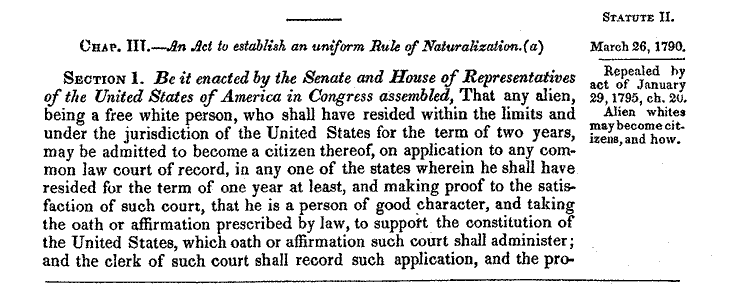
After they began to amend the law, the phrase "Free White Person" stuck. Now everyone who was allowed to apply and become a U.S. citizen was a "free white person" regardless of their skin tone. There was no caste system based on skin color used by the colonists in 1790, as it pertained to immigration. The following image has been circulating for a long time, and clarifies who the original "free white persons" were.
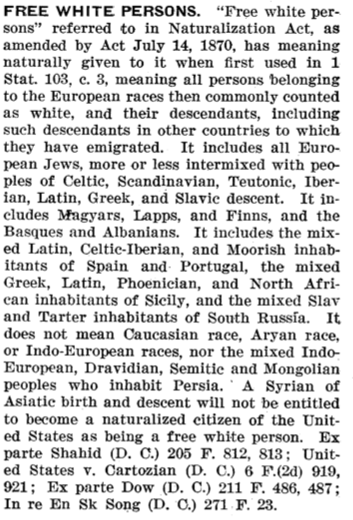
As shown, the phrase originally only applied to "white" people of western European descent, or "all persons belonging to the European races then commonly counted as White."